


For much of the past decade, progress in medical imaging AI has been driven by increasingly capable algorithms designed to solve specific clinical problems. Today, the landscape is expanding. Foundation models are emerging alongside specialized clinical AI, generative AI, automation, and other technologies that are creating new possibilities across imaging and the broader care journey.
For Sham Sokka, Chief Operating and Technology Officer at DeepHealth, the opportunity isn’t simply to build more capable models. It’s to rethink how intelligence works within imaging, how people work with that intelligence, and what this evolving relationship can make possible.
The evolving role of foundation models
Foundation models are generating a lot of attention in healthcare AI. How do you see their role evolving?
Foundation models are an important development, but I think we need to be precise about what we mean by them.
A foundation model is exactly that: a foundation. It’s a broadly trained model that can serve as a building block for developing multiple downstream capabilities. That’s different from saying we’re going to have one generalized model that does everything in radiology.
I don’t see the future as a choice between foundation models and the specialized AI we’ve spent years developing and validating. They have different strengths, and I think more and more we’re going to see them work together.
A foundation model might identify a potential finding, for example, and then call on a specialized capability to perform a precise measurement, quantify disease, or provide validated clinical analysis.
The important question is how to use the right intelligence for the right task and how those capabilities can work together.
A new approach to AI
How does that change the way healthcare organizations should think about AI?
For a long time, the industry has largely evaluated one AI model at a time. You identify a clinical problem, find the best algorithm for that task, validate its performance, and deploy it.
That approach becomes harder to sustain as the AI ecosystem grows. Beyond clinical AI, intelligence is increasingly being applied across the imaging workflow, from referral and scheduling through acquisition, interpretation, reporting, follow-up, and patient engagement.
While this means healthcare organizations need to think more holistically about where intelligence can create value across their workflows and what clinicians, care teams, and patients need from it, they shouldn’t have to become experts in assembling the underlying technology to make that happen.
That’s increasingly the responsibility of the technology partner: bringing together the right capabilities and making them work as part of a connected clinical and operational environment, rather than leaving healthcare organizations—or the people using the technology—to piece everything together themselves.
Individual model performance remains essential. But the value of AI increasingly depends on both the strength of the individual capabilities and how effectively they work together within the workflow.
Bringing AI capabilities together
What does it actually take to make these different AI capabilities work together?
This is where the challenge becomes bigger than the individual AI models.
It’s not simply a matter of connecting them. You first need to understand what clinicians and care teams need at different points in the workflow. From there, you can determine where each capability belongs, how the technologies should interact, and how information needs to move between them.
That’s why the role of the technology partner needs to evolve. It’s no longer enough to offer a collection of algorithms. The partner needs to take responsibility for bringing those capabilities together—integrating and advancing them, and architecting how different forms of intelligence work together across workflows.
Taking responsibility for that complexity requires both the technology to make it possible and the operating experience to make it work in practice.
That’s how we think about our role at DeepHealth. We’re bringing together a comprehensive portfolio of AI-powered capabilities with our clinical operating experience on a connected platform to create intelligent radiology experiences.
Architecting intelligence into the workflow
Does that also change the relationship between clinicians and AI?
Yes. I think this is one of the most important changes ahead.
With highly specialized AI, trust has largely been based on oversight. A model performs a defined task, and the clinician evaluates its output. You can validate that model against that task and understand how well it performs.
As AI capabilities expand and begin interacting with one another, that relationship changes. A system might identify a finding and invoke another capability to analyze it. It might bring in relevant clinical context, generate part of a report, or help initiate what happens next. You can’t think about that purely as a series of individual outputs to oversee.
We’re beginning to move from an oversight model of trust toward a more interactive model of trust. That kind of interaction demands a different experience.
AI shouldn’t simply produce an output that sits outside the workflow waiting to be checked. It can contribute more interactively throughout the workflow, surfacing relevant information, introducing another perspective, or helping someone understand what matters.
That starts to change the relationship from AI as a tool to AI as a thinking companion.
From AI tool to thinking companion
What does that kind of intelligent experience look like in radiology?
The complexity should recede into the background.
The person using the technology shouldn’t have to think about which model is doing what or move between applications to assemble the intelligence themselves. What people experience should be the right insight, automation, context, or guidance appearing naturally within the way they work and receive care.
For a radiologist, that intelligence might contribute directly to interpretation. But imaging touches many other people across the care journey. An emergency physician may need to understand the significance of a finding. A specialist may need information that informs what happens next. A care team may need to coordinate follow-up, while a patient may need guidance navigating their care.
The experience changes according to the person and the need, but the principle is the same: intelligence should bring forward what’s needed, where and when it’s useful.
That’s what I mean by an intelligent experience. The sophistication can happen behind the scenes. What people experience is information, guidance, context, and action coming together intuitively within the way care is delivered.
Can you give an example of what an “intelligent experience” looks like in practice?
Traditionally, we’ve tended to think about AI in radiology in one of two ways. Either as a “first reader” that analyzes an examination before the radiologist. Or as a specialized tool that performs a task and presents an output for the radiologist to review.
But an intelligent experience goes further than AI taking a first pass at an exam or generating a draft report. What I call “co-reading” is different. It’s an interactive relationship in which the radiologist and AI work together throughout the interpretation.
Different capabilities can contribute at different points along the way. A foundation model might help develop a broad understanding of an examination or generate an initial draft, while specialized clinical AI provides disease-specific analysis, measurements, quantification, or corroborating evidence. Visualization and reporting can bring that evidence directly into the environment where the radiologist develops the interpretation.
But co-reading isn’t simply about putting all those capabilities in one place.
The radiologist is interacting with the intelligence—questioning it, evaluating it, adding clinical context, resolving uncertainty, and determining what matters. In response, AI might surface something the radiologist hadn’t considered, bring forward relevant evidence, or provide information that helps the radiologist consider the examination from another angle.
The radiologist isn’t simply overseeing AI, and AI isn’t replacing the radiologist. The radiologist is reasoning with the intelligence in a new way.
That’s what I mean by AI as a thinking companion. It’s part of the process of developing the interpretation rather than another output the radiologist has to check.
What becomes possible in healthcare
If you allow yourself to look further into the future, what could this evolution of AI make possible for healthcare?
If we allow ourselves to look a little further ahead, there are some really exciting possibilities. Some may still be years away, and we shouldn’t pretend we know exactly how the technology will evolve. But I think we can see the direction of travel.
We may move toward much more generalized forms of intelligence that understand not only what’s present in an image, but also the broader context around it. For example, why the examination was ordered, patient history and clinical context, what question the clinician is trying to answer, and what may need to happen next.
That doesn’t necessarily mean one model that does everything. It could mean intelligence that understands the problem, determines what capabilities are needed, draws on specialized tools when they’re useful, and works interactively with people throughout the care journey.
Radiology is an especially powerful place for this evolution to take shape because imaging informs so many of the decisions that determine what happens next in care. Is disease present? Has it progressed? Is treatment working? Does a patient need intervention or follow-up? Imaging helps turn uncertainty into information people can act on.
Imagine what that could make possible for healthcare.
Intelligence could connect information that today sits in different places. It could recognize patterns across a patient’s journey and bring forward knowledge at the moment it’s needed, helping identify disease earlier, recognize when follow-up is needed, or guide a patient through their next step in care.
Over time, I also think the boundaries between individual models and applications could become much less important to the people using them. You may not know—or need to know—which model is performing a particular task. The intelligence could understand what you’re trying to accomplish, the context around that need, and which capabilities to bring together in response.
That’s where the idea of AI as a thinking companion becomes much more powerful. We’re talking about intelligence being integrated across more of the process of generating knowledge and delivering care, while people bring expertise, context, judgment, and their human understanding of what matters.
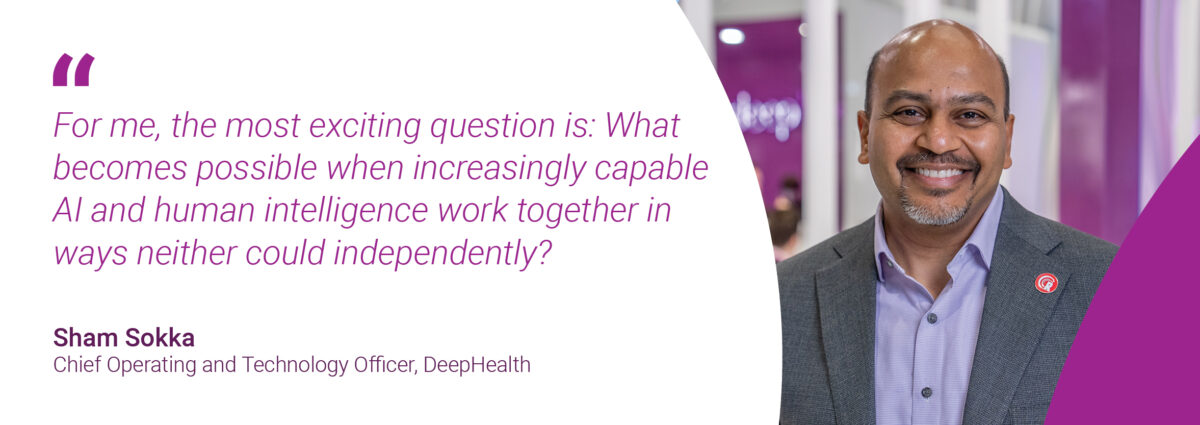
The people in the loop make decisions, take responsibility for them, and turn those decisions into action. For me, the most exciting question is: What becomes possible when increasingly capable AI and human intelligence work together in ways neither could independently?
We’re not fully there yet. But we’re beginning to see what that future could look like.
Find out more about how DeepHealth’s leading-edge technologies can support you.