


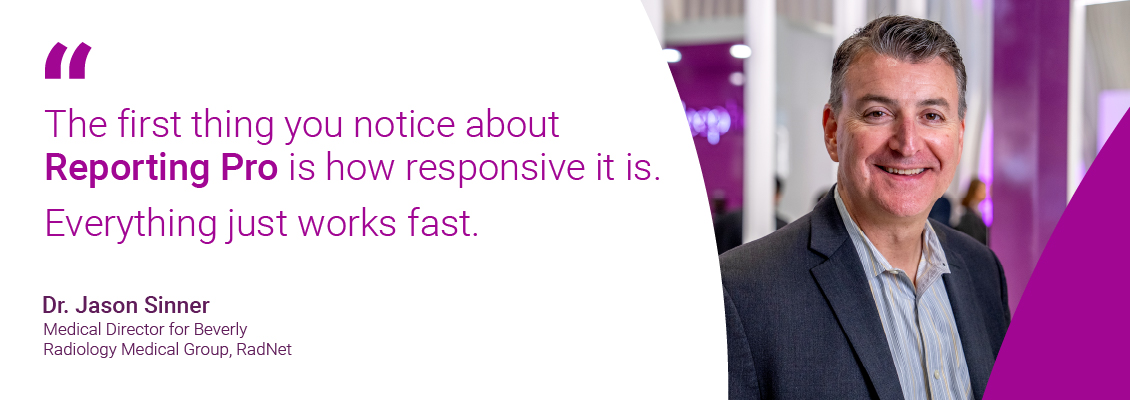
Like most radiologists, Dr. Jason Sinner had grown accustomed over the last two decades to a familiar legacy reporting tool and workflow that had changed very little over that time. Recently, Dr. Sinner shared his experience using Reporting Pro and why he believes it represents a new way of thinking about radiology reporting.
“Reporting hasn’t really evolved in almost 20 years. We’re finally thinking about it differently.”
For Dr. Sinner, using Reporting Pro is changing the way he sees reporting—and that difference is tangible in his day-to-day work.
“The first thing you notice about Reporting Pro is how responsive it is. Everything just works fast. Moving through reports, signing studies, navigating the workflow—those few seconds you save over and over again really add up.”
But speed wasn’t what impressed him most. Voice recognition accuracy immediately stood out.
“The fidelity of the voice recognition is remarkable. I’m not slowed down having to correct mistakes. With Reporting Pro, 99.9% of the time it’s exactly what I said. That’s a big deal.”
More than reporting software replacement
For Dr. Sinner, Reporting Pro represents far more than a replacement for legacy reporting software.
It represents the next evolution of radiology reporting.
“People are finally realizing that reporting itself hasn’t evolved in almost 20 years. This isn’t just voice recognition anymore. What Reporting Pro offers is a much more cohesive reporting experience.”
Instead of radiologists having to work across multiple disconnected applications, Reporting Pro brings reporting, imaging, AI, structured workflows, and clinical information together into a single experience.
“The images, the report, the AI—they all come together in one connected system. It doesn’t feel like separate applications anymore. It feels like one integrated experience.”
Integration that extends beyond today’s reporting workflow
As AI-powered draft reporting, impression drafting, structured reporting, and clinical decision support continue to evolve, Dr. Sinner believes radiologists will spend less time managing software and more time practicing medicine.
“We’re moving toward draft reporting where AI generates much of the report, and the radiologist applies their clinical judgment. That’s very different from looking at an image, dictating, checking the text, and repeating that process over and over.”
Perhaps most importantly, Dr. Sinner points to something most reporting platforms have struggled to deliver: continuous improvement.
Because Reporting Pro is developed in close partnership with practicing radiologists, feedback doesn’t disappear into a years-long development cycle.
“I have direct access to the engineers. We can give feedback and see changes in days or weeks—not years. That’s the secret sauce. The product keeps getting better because the people building it are listening to the people using it.”
He believes that continuous collaboration ultimately benefits more than radiologists.
Standardized radiology reporting helps create greater consistency across practices, giving referring physicians confidence that reports—and recommendations—are based on the same evidence regardless of who interpreted the study.
“The impact on patient care is tremendous. Instead of six different versions of a report from six different radiologists, you’re getting one consistent standard. Referring physicians know where to look, patients receive more consistent recommendations, and those recommendations are based on established clinical guidelines.”
For Dr. Sinner, that’s where the real value lies. Better reporting isn’t simply about making radiologists more efficient. It’s about creating greater consistency across the entire care team, helping ensure that every patient benefits from the same evidence-based approach, regardless of who interprets the study.
The future of radiology reporting
“It’s more than reporting now. It’s a fully integrated output of information—from the RIS, from AI, from the radiologist—all working together in one system.”
As imaging continues to evolve, AI will no longer sit alongside the reporting workflow but will become part of it. In fact, Reporting Pro is helping healthcare organizations build the next generation of intelligent reporting.
The organizations best positioned for the future will be those that move beyond disconnected applications toward integrated platforms that continuously learn, evolve, and support more consistent clinical decision-making.
Planning your migration from legacy reporting?
Talk with a DeepHealth expert today