


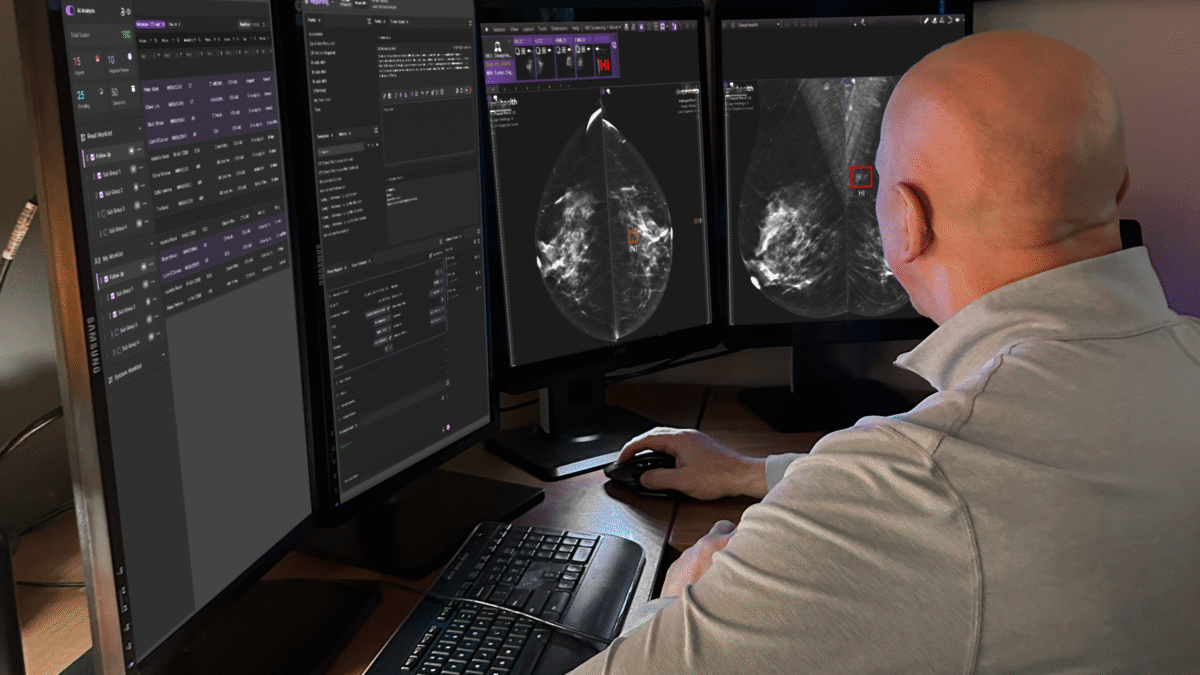
While AI’s role in diagnostic imaging is well-established, one part of the workflow has remained largely unchanged despite its central role: the report.
Reporting is where a clinical decision becomes the clinical record. It is where a radiologist’s judgment, including years of training, reasoning, and pattern recognition, is communicated to the care team and ultimately shapes a patient’s care journey.
The radiology reporting workflow is one of the last major clinical processes yet to be fundamentally transformed by AI. It represents the most significant opportunity to transform both efficiency and clinical outcomes.
From blank page to structured starting point
While reporting has gotten more attention lately, most organizations are still running reporting workflows that were designed before AI was anywhere near a reading room.
In a typical radiology reporting workflow, a radiologist finishes reviewing images, switches to a separate dictation system, opens a largely blank document, and manually reconstructs findings that already exist somewhere else—in AI-generated findings, imaging studies, prior reports, and clinical records scattered across other applications. They assemble a narrative from scratch, then reconcile it with measurements generated in yet another system.
This puts the cognitive burden of integration squarely on the radiologist, at the exact moment when their attention should be on clinical judgment. Radiology teams are managing rising imaging volumes and persistent workforce shortages; a reporting process that requires radiologists to manually reconstruct information at every step compounds these challenges.
The necessary shift requires moving reporting from a blank-page dictation exercise to a structured, AI-informed workflow. The radiologist still owns the interpretation. But instead of starting from nothing, they start from a structured draft that already reflects imaging findings, relevant priors, AI-generated measurements, and clinical context surfaced during the read. DeepHealth built Reporting Pro around exactly this model, designed to integrate into existing radiology environments without displacing the workflows and templates clinicians already rely on.
The difference in day-to-day experience is significant: Radiologists move from creating reports to refining them, from searching for context to evaluating it. That changes how they spend their time and how much of their expertise actually makes it into the final document.
AI can also do things at the point of reporting that weren’t previously possible at scale: flag inconsistencies before sign-off, surface relevant guideline-based follow-up recommendations, standardize language across readers and sites. Quality assurance that used to happen downstream can happen before the report leaves the reading room.
Where reporting efficiency meets clinical impact
Beyond documentation efficiency, AI-assisted reporting enables a more connected diagnostic process—one where critical findings reach care teams faster, recommended actions don’t disappear into unstructured text, and follow-up pathways can be tracked.
Radiology has always been a field defined by the quality of clinical judgment. The best radiologists are the ones who catch what others miss, who communicate findings in ways that drive action, and who understand how their work fits into a patient’s broader care journey.
The goal of integrated, AI-powered reporting is to give more radiologists more room to do exactly that. That’s a shift worth building toward.
Find out how AI-powered Reporting Pro can advance your radiology reporting workflows.